

Texas Drinking Water Systems Draw Federal Concerns

by Neena Satija

More than 310 public drinking water systems in Texas — nearly 4.5 percent of the state’s regulated public water systems — have quality issues that haven’t been adequately addressed, federal officials told the Texas Commission on Environmental Quality this year. That is the highest percentage in the nation, according to the Environmental Protection Agency.

Most are small public water systems, like mobile home parks, serving a few hundred people or fewer. But a few are larger and serve thousands.

TCEQ officials say the federal estimate is outdated and high; by their account, about 4 percent of systems have issues that need more attention. The agency said it has dramatically stepped up its enforcement in the past year, training more staff and pursuing more than 100 public water systems in recent months for clean water violations.

Still, the EPA’s concerns and additional data suggest that keeping up with the 7,000 public water systems subject to state regulation in Texas has been a huge challenge. The TCEQ’s enforcement division now has 107 full-time employees, compared with 117 in 2007, though its annual expenses have stayed relatively constant at about $5.5 million.

“There could be more resources brought to bear,” said Robert Doggett, general counsel for Texas RioGrande Legal Aid, which serves border regions where many public water systems have committed clean water violations.

Some districts have the money to fix their water issues, Doggett said. “Others are poor, and they don’t have the money and expertise, and they need help. Either way, it’s a problem, and why hasn’t the state agency done much about it?”

In an email, TCEQ spokesman Terry Clawson said, “Texas’ drinking water systems face a wide array of challenges in meeting the public health protection standards aimed at ensuring safe drinking water.”

In its March letter to the TCEQ, the EPA wrote that an alarmingly large number of systems in Texas had problems that took the TCEQ too long to seriously address. Dozens have not been compliant with clean water law for close to five years, according to the EPA.

A separate EPA review done in 2012 found that nearly a quarter of public water systems in Texas had committed significant violations of water law — either because of unhealthy levels of contaminants, or because they failed to test water properly and frequently enough. That’s a higher percentage of violations than in other large states, such as California, where 8 percent of water systems had committed significant violations.

Many of the systems with the most severe problems are in remote areas and serve only a few dozen people. Their water resources have naturally occurring contaminants like arsenic that are enormously expensive to remove. Operators also constantly change or are hard to reach, making regulation by the state particularly difficult.

That appears to be the case, for example, with “Cyndie Park II Water Supply Corp.,” which serves just over a dozen households in a Nueces County colonia. The water comes from portions of the Gulf Coast Aquifer that have high levels of arsenic. Long-term human exposure to arsenic has been linked to liver, prostate and many other types of cancer.

For more than 10 years, the TCEQ has regularly cited Cyndie Park II WSC for providing water with dangerously high levels of arsenic as well as coliform — microorganisms that could indicate the presence of disease-causing bacteria such as E. coli. It has also sent dozens of notices in recent years alleging that the system is not routinely testing its water or reporting test results to the state. But there was no apparent improvement; last fall, arsenic levels were at 15 micrograms per liter, according to EPA data; the federal limit is 10.

In 2011, residents were asked on three separate occasions to boil their water because of problems with the system, according to state data. The agency sued Cyndie Park II WSC in 2012 and demanded $150,000 in fines, but never received a response.

“None of us here drink the water,” said Robert Burleson Jr., a retired resident who lives with his wife on a fixed income. “We don’t cook with it. All we do is shower and wash dishes.”

Burleson said he spends about $10 per week on water jugs in Corpus Christi, 17 miles away. That’s in addition to the water bill he pays Cyndie Park II WSC. “That’s about all anybody can afford out here,” he said. The median annual income for area households is less than $30,000.

Burleson used to serve as president of the water cooperative’s board, but quit — with the rest of the board members — a few years ago out of frustration. “Nobody had any money” to fix the arsenic problem, he said. “I had engineers do work on it and put in for grants and stuff, but we never got anything.”

Nueces County received $150,000 from the TCEQ to install an arsenic removal system that will come online in the next few months. But County Commissioner Joe Gonzalez said many other problems remain, including water lines that are cracking and ready to break. Water service was out for nearly a month last year because of such issues, he said. Some of the $150,000 remains and will be used to fix the water lines, but more is needed.

Gonzalez said that his long-term goal is to provide residents with a new supply of water. Along with arsenic, other contaminants and high salt levels consistently plague the groundwater that supplies the colonia and other nearby residents today.

Planning, design and construction costs to connect to a larger public water supply system that relies on cleaner surface water would be around $1 million, and the county plans to apply for grants from the state. But it will likely be years before any construction begins.

“We try to do what we can with the money we have, but sometimes those grants are hard to come by,” Gonzalez said.

Source:  The Texas Tribune.

Pure Water Gazette Fair Use Statement


Pure Water Gazette Technical Wizard Pure Water Annie Explains How Water Moves Through An Undersink Reverse Osmosis Unit

In modern home reverse osmosis units,  tap water, driven by normal city water pressure, flows first through a carbon pre-filter, which removes organic contaminants including chlorine and its by-products.

Next, the water enters the reverse osmosis membrane, a very tight, sheet-like filter, that allows water to pass but rejects dissolved solids like sodium and impurities like lead and arsenic. Some of the water entering the unit is used to cleanse the membrane surface. This water, called brine or concentrate, flows to the kitchen drain pipes.

The purified water leaving the membrane, which is called permeate, is stored in a small storage tank until it is needed. When the RO unit’s ledge faucet mounted on the sink is opened, the purified water, or permeate,  is forced by air pressure inside the storage tank through another carbon filter, which gives it a final polish, and from there to the ledge faucet.

This is a simplified description of a three-stage RO unit. Additional stages like sediment filters and additional carbon filters or specialty filters can be included. The simplified description omits a few very essential parts like flow control devices, check valves, and an automatic shutoff devices that stops the inflow of water when the storage tank is full.

What is microcystin?

The harmful toxin responsible for the shutdown of Toledo’s water taps is on the rise, and experts suggest that farming and climate change may be to blame.

by Melissa Breyer

Over the weekend, city officials in Toledo, Ohio, asked residents served by the municipal water system to refrain from using their tap water. Up to 500,000 people in the state’s fourth-largest city were told not to drink the water, or to use it for brushing their teeth, for cooking or giving it to their pets. Children and those with weak immune systems were urged not to bathe in the water.
All thanks to a tiny but potent toxin called microcystin.
Microcystins are hepatotoxins (liver toxins) produced by cyanobacteria. Cyanobacteria are also known as blue-green algae, and they cast their distinctive hues on surface water when conditions are favorable for growth of algal blooms, according to the EPA. When released, the toxins may persist for weeks to months. While the liver is the favored target of microcystins, skin, eyes and throats can suffer as well.
Blue-green algae are among the oldest organisms on the planet, and they can multiply quickly in water with high nutrient levels — primarily an abundance of phosphorous ­— especially when the water is warm and the weather is temperate.
The Great Lakes area, the world’s largest freshwater system, has been particularly hard-hit by algae blooms. Lake Erie (the source of Toledo’s water) suffered significant blooms between the 1960s and 1980s, fed by urban and industrial waste. Although the lakes got a bit of a reprieve from the blooms in the ensuing years, the last 10 years have seen a steady increase, generally attributed to the agricultural runoff of commercial fertilizer. The last three years have been notably bad. Experts say the return is largely due to changes in farming practices, including larger farms and new fertilizing methods. The result of those trends is more phosphorous heading into the lakes.
Lake Erie has also grown more susceptible to the algal blooms because of invasive species and climate change. “Heavy rains in spring and early summer — a critical time for algal bloom formation — cause more phosphorus to enter the lake through agricultural runoff,” notes The Guardian. “Hotter temperatures then cause the blooms to spread.”
Two invasive species, zebra and quagga mussels, exacerbate the problem due to their dislike of microcystis. “They selectively feed on other phytoplankton species, removing competitors so microcystis can thrive,” says Colleen Mouw, a researcher at the University of Wisconsin-Madison. “As the mussels digest, they release phosphate and ammonia into the water, and these nutrients give microcystis an additional boost.”
Fortunately, poisoning from the toxin can’t be spread from person (or animal) to person. No human deaths from ingestion of microcystins have been reported; but dogs, wildlife and livestock have died following exposure.
The Iowa Department of Public Health notes that the toxin can affect people in various ways:
  • Microcystin on the skin may produce a rash, hives or skin blisters (especially on the lips and under swimsuits).
  • Swallowing water containing microcystin may cause gastrointestinal symptoms such as stomach pain, nausea, vomiting, diarrhea, severe headaches and fever.
  • Inhaling water droplets containing microcystin can cause irritated eyes and nose, cough, and sore throat, chest pain, asthma-like symptoms or allergic reactions.
  • Exposure to large amount of microcystin can cause liver damage.
Symptoms can present in as little as a few hours or days, but generally the symptoms take around a week to show up. The only treatment is addressing the symptoms.
Here’s what to do if you think you may have been exposed by swimming in, swallowing, or breathing in water where a blue-green algae bloom exists:
  • Wash with soap and water after contact.
  • Avoid drinking alcohol.
  • Do not use acetaminophen.
  • Let your doctor know if you are experiencing any symptoms.

Pure Water Gazette Fair Use Statement

We Are All Californians


Posted August 4th, 2014

We Are All Californians

by Gene Franks

I’m prayin’ for rain in California,


So the grapes can grow and they can make more wine,


And I’m sittin’ in a honky in Chicago,


With a broken heart and a woman on my mind. 

This lyric from a Dean Martin recording says a lot about America’s current dilemma.  Every day that the rain doesn’t fall in California is a day that grapes don’t grow, and lettuce doesn’t grow, and almonds don’t grow, and avocados don’t grow, and lemons don’t grow, and walnuts don’t grow, and broccoli doesn’t grow, and oranges don’t grow, and rice doesn’t grow, and apples don’t grow, and marijuana doesn’t grow.

In an article called “What would we eat if it weren’t for California?” author Brian Palmer asks,

If California were to disappear, what would the American diet be like?

Expensive and grainy. California produces a sizable majority of many American fruits, vegetables, and nuts: 99 percent of artichokes, 99 percent of walnuts, 97 percent of kiwis, 97 percent of plums, 95 percent of celery, 95 percent of garlic, 89 percent of cauliflower, 71 percent of spinach, and 69 percent of carrots (and the list goes on and on). Some of this is due to climate and soil. No other state, or even a combination of states, can match California’s output per acre. Lemon yields in California, for example, are more than 50 percent higher than in Arizona. California spinach yield per acre is 60 percent higher than the national average. Without California, supply of all these products in the United States and abroad would dip, and in the first few years, a few might be nearly impossible to find. Orchard-based products in particular, such as nuts and some fruits, would take many years to spring back.

About 40 years ago Rodale Press funded a study called the Cornucopia Project that questioned the wisdom of putting all our agricultural eggs in one basket.  Our food system is wonderful at making money, but it may not be the best plan if providing a secure supply of food for the nation is the goal. The Cornucopia writers pointed out that a disruption in the system could turn into a national calamity.  Anything that makes it difficult (or unprofitable) to haul broccoli from California to Cleveland could easily leave Cleveland without broccoli.  And carrots.  And celery.

Maybe the current drought is a wake-up event that can teach us the wisdom of eating more locally grown food and supporting the local farmers who grow it.  The factory farm model is profitable when all goes well, but it can leave us all high and dry when difficulties, like the current drought,  arise.

But as for now, like good old Dean Martin, I’m prayin’ for rain in California.  I really like broccoli.  And walnuts. And Lundberg’s California rice. We’re all Californians.

Garden Hose Day 2014


Posted August 4th, 2014

2014 Garden Hose Day “disappointing”

The 2014 National Garden Hose Day,  celebrated August 3,  was, according to national event chairman Bob Lewis, “disappointing.”  Lewis said that this year’s response to the event fell far below expectations.  Most would simply say that the event was a big flop.

The National Garden Hose Day has experienced consistent, enthusiastic annual growth since its inception, but the 2014 Garden Hose events were poorly attended in most cities around the US.

In addition, sales of products related to the celebration fell off sharply from last year. One marketing expert said. “I think we overestimated the commercial potential of the event. For one thing,  garden hose sales are flat nationwide.  There are simply too many garden hoses out there, and they last a long time.  When a family has three good garden hoses, it’s hard to sell them another one.  Let’s face it: garden hose innovation is difficult. You can’t sell a hose because  it has a fancier operating system. Drought in some areas has also driven sales down.  If you can’t water your lawn, you don’t need a spiffy new garden hose.”

The slump in event attendance has also been blamed in part on on drought and water shortage in many parts of the country.  People do not get excited about recreational events that center on water when water is being rationed. Consequently, one of last year’s most popular events, the Garden Hose Blast (see picture below, from last year’s contest in Des Moines, IA), was cancelled to save water. “Not having the Hose Blast,” Lewis said, “definitely hurt ticket sales.  The Hose Blast was really a crowd pleaser.”


Enthusiasm for National Garden Hose Day may also have been dampened by unexpected attacks on the celebration by several conservative talk show hosts whose motives were unclear.  It has been suggested that the totally secular nature of Garden Hose Day as well as its lack of patriotic significance have made it unpopular in certain circles. Event Chairman Lewis said, “Garden Hose Day is mainly just about about having a good time. Some  Americans seem uncomfortable about having a good time unless they can find justification.  If Moses had owned a garden hose, or if Ben Franklin had flown his kite with one, Garden Hose Day would be an easy sell.”

Event Highlights

The Tulsa Tugboats, last year’s third-place finisher in national garden hose pull competition, this afternoon bested their arch-rivals the Wichita Whippets in the 2014 National Garden Hose Pull championship match in Minneapolis. Although the Whippets had a distinct weight advantage, the Tugboats outlasted them to take the title.  The event favorite, the Cleveland Pack Mules, were eliminated early in spite of a stellar performance from star puller Paul Browning.

RO Tank Fundamentals


Posted August 4th, 2014

What’s Inside a Reverse Osmosis Tank?

Among the most frequently asked questions about the small storage tanks used for home reverse osmosis units is what type metal they are  made of.  The answer is that it doesn’t matter from the point of view of water purity because the water does not touch the walls of the tank itself.

In some tanks, especially older style tanks, the water is contained within a bottle made of an inert rubber material called butyl. The butyl bladder is surrounded by a pocket of air that pushes the water out of the tank. The only metal that the water touches is the threaded top stem of the tank where the water enters and  exits the tank.  In most modern tanks, the top stem is made of stainless steel.

Many current metal tanks use a slightly different arrangement.  Below is  a cutaway of a top quality modern Aquasky RO tank.

In the Aquasky tank the  upper and lower halves of the tank are divided by a butyl partition, which can be seen through the window that has been cut from the tank. The upper portion of the tank contains a polypropylene liner that is visible in the picture.  The water touches only the butyl partition on the bottom, the polypropylene liner, and the stainless tank neck.  It does not touch the metal of the tank itself.

Beneath the bladder is an air-filled compartment that provides pressure to push the water from the tank when the faucet is opened.  The small blue cap at the bottom left of the picture covers the valve where air is added to the tank.


And finally, what the world has been waiting for, a clear RO tank.

rotankclear

The tank above, which we received as a promotional sample from the Chinese manufacturer, is made of clear plastic and has a  replaceable transparent plastic bag that holds the purified water. An air charge on the outside of the bag drives the water out of the tank.The picture shows the tank filled with water.

For a selection of RO tanks:

Small undersink units.

Larger tanks, up to 80 gallons.


Water Treatment for Microcystin

by Gene Franks

This morning’s water news (August 3, 2014)  is filled with stories and pictures of the episode of microcystin contamination in the city of  Toledo, Ohio water supply.  Officials in Toledo warned residents not to drink the water and cautioned that boiling (a frequent emergency strategy for bacterial contamination) would only make things worse.  This is no small issue since it leaves 500,000 people without drinking water.

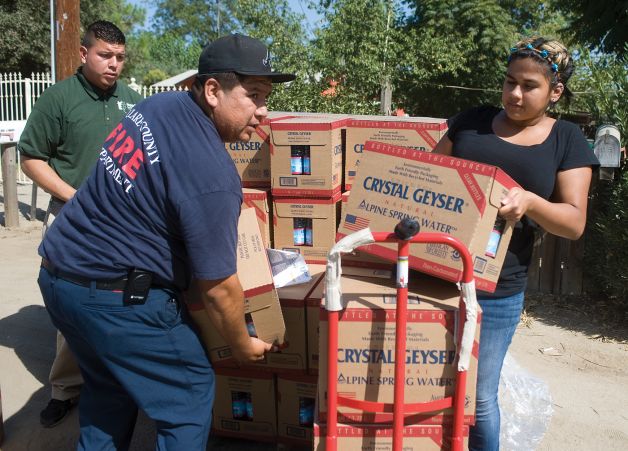
As usual, bottled water is the quick fix for supplying potable water, but providing bottled water for half a million people is no small matter.  The picture below suggests that supplies were in short supply.

I watched several news reports and read a few news releases.  Not one mentioned that home water treatment devices owned by the residents involved might be used.

Microcystin is one of a large number of toxins that are grouped under the name of cyanotoxins, and microcystin itself exists in several forms.  It all starts with blue-green algae,  also called cyanobacteria,  which are microscopic aquatic organisms. They are ancient creatures that  produced Earth’s earliest fossils.  Some blue green algae (often identified as “pond scum”) are important sources of human nutrition but others put out toxic ingredients called cyanotoxins that are harmful to humans.  Algae contamination of lakes has become very common because of overuse of fertilizers. 

Green Slime that plagues Great Lakes results mainly from fertilizers used by big agriculture.

According to Water Technology magazine, “Algae-containing water can be swallowed, can contact the skin or is inhaled in aerosol-like droplets while swimming or showering. Cyanotoxins can cause gastrointestinal and lung ailments; allergic responses; skin and eye irritation; liver damage; tumor growth; and neurotoxic (nerve) reactions. Effects of long-term consumption uncertain.”

Advice on water treatment for cyanotoxins from a web search ranges from the overly complex to the downright simple minded.  Bulletin board advice suggests “popping some activated charcoal to help neutralize these toxins” and taking milk thistle to protect the liver.  At the other extreme are a doctoral dissertation long on theory and short on practical advice and a technical paper on “Removal of microcystin-LR from water by polymers based on N-vinylformamide structure.” Another study features “a new kind of low-cost syntactic adsorbent from bamboo charcoal and chitosan” for use in impoverished regions.  Yet another describes an experimental project with a ” hollow fiber microfiltration pilot plant (2–4 m3/h)” in which ” high removals of cyanobacteria (98%) and total algae (99%) were obtained.”  Not very helpful for  the home owner who wants protection from microsystin.

The WHO and the EPA offer advice aimed mainly at public water suppliers, not individuals.  In both cases, the treatment recommendations are broad and generalized.  The EPA, for example, notes the effectiveness of chlorination and potassium permanganate to control the organism but warns of problems with side effects. Likewise, the possibility of using flocculation and subsequent filtration has its pros and cons.   Powdered activated carbon can be used to remove toxins as can granular activated carbon.  “GAC filters are effective in removing microcystins if they are properly replaced or regenerated when total organic carbon breakthrough is high. Usually, higher concentrations of activated carbon are necessary to effectively remove toxins; repeated treatment may be needed to totally remove the toxins completely.”  The EPA also notes the effectiveness of UV for controlling cyanotoxins but says that high doses are needed.

These, as mentioned, are strategies for city water departments, not homeowners. In general, they are not commonly practical for city water suppliers.  Carbon beds large enough to effectively remove toxins of this nature are not used by most municipal suppliers.

Here’s what Water Technology Magazine says about treating cyanotoxins:

Activated carbon is effective and can resolve cyanobacteria-caused taste and odor issues.  Reverse osmosis (RO), nanofiltration and ultrafiltration will remove/reduce single-cell cyanobacteria, and may also help reduce cyanotoxins.  Disinfection methods (such as chlorination) may kill cyanobacteria but not eliminate the cyanotoxins they release.

Finally, the search for microsystin with a variety of keywords got one persistent ambulance chaser ad for ceramic filters. The linked site itself does not discuss microsystin, but the ad implies that the ceramic filters advertised will take care of the problem.

What I would do if I lived in Toledo

What conclusions should we draw from this in regard to common home water treatment devices?

Although untrafiltration, microfiltration, and nanofiltration devices have been used with some success to treat microsystin, these are not commonly used in homes. Reverse osmosis units, however, are common, and RO has been shown to be 95% plus effective in this area.  If I lived in Toledo,  I would trust my undersink RO unit, with its extremely tight membrane and two carbon block filters. Keep in mind that the same reservations that apply to using RO in standard “boil water” situations also apply here: While the contaminants in question are too large to pass through the RO membrane, the device itself was not designed for long-term “sanitation” of water that is infested with dangerous bacteria. Live organisms can grow around o ring seals.  But, on a short term basis, I would trust my RO unit.

Ultraviolet systems used in domestic water treatment are not potent enough to inactivate cyanotoxins.

Chlorine, in high enough doses, can control cyanotoxins, but the dosage used by public water supplies is too low.  Chloramine is not effective against cyanotoxins.

I can’t find evidence that would make me trust a ceramic filter in this situation, although a good ceramic filter with a carbon core would probably produce safe water.

To wrap it up, I would drink water from my home RO unit if I lived in Toledo, but I would be reluctant to recommend that others do the same. As they always say, “More research is needed.”


Root Vegetables Irrigated With Treated Wastewater Can Take Up Certain Drugs

Wastewater Reuse: A field study shows that carrots and sweet potatoes accumulate an anticonvulsant drug and a drug metabolite at potentially unsafe concentrations


by Janet Pelley

 In an experimental plot, scientists in Israel irrigated sweet potatoes with treated wastewater to determine if the vegetables accumulated pharmaceuticals from the water.

Faced with dwindling sources of freshwater across the globe, growing numbers of farmers are using wastewater to irrigate food crops. This wastewater, however, can contain trace amounts of pharmaceutical compounds excreted by people, so scientists want to know how much of the drugs make it into plants and onto dinner plates. A new study of root vegetables irrigated with treated sewage effluent finds that, although many drugs don’t accumulate at detectable levels, a couple can build up to concentrations that may exceed safe exposure levels (Environ. Sci. Technol. 2014, DOI: 10.1021/es5017894).

About half of Israel’s agriculture relies on irrigation with treated wastewater, and the practice is gaining ground in Africa, Asia, Mexico, and in parts of the U.S., including California and Arizona, says Tomer Malchi, a soil scientist at Hebrew University of Jerusalem. But only a few previous studies have gauged plant uptake of pharmaceuticals in a farm setting, he says, and these did not estimate the health risks to people nor look at drug metabolites.

Malchi and his colleagues, including Benny Chefetz, decided to track 14 common pharmaceuticals and two metabolites of one drug in irrigation water and then in the edible parts of crops. The scientists grew sweet potatoes and carrots outdoors in 0.5-m3 plots irrigated with the same water used by local farmers: treated wastewater from the city of Kiryat Gat, Israel. They measured concentrations of the compounds in the irrigation water, soil, and plant tissue using liquid chromatography/mass spectrometry. In the two vegetables, the scientists did not detect any drugs except for caffeine and the epilepsy drugs lamotrigine and carbamazepine. These nonionic organic molecules cross cell membranes easily and thus are more likely to be taken up by plant roots. They also found 10,11-epoxycarbamazepine, a metabolite of carbamazepine. Concentrations of the compounds ranged from 0.013 to 4.130 ng per g of the vegetables’ fresh weight.

Malchi and his colleagues then determined the threshold of toxicological concern (TTC) for the compounds, a method that the European Food Safety Authority uses to establish safe levels in food of chemicals that lack firm toxicological data. The method assigns compounds to one of four levels of potential toxicity, each of which establishes an acceptable daily consumption value, above which there would be a possible risk to human health.

On the basis of the concentrations detected in the vegetables, “an adult would have to consume hundreds of kilograms of sweet potatoes or carrots from our study daily to reach the TTC level for caffeine or carbamazepine,” Malchi says. For 10,11-epoxycarbamazepine, a child would need to eat 90 g/day of sweet potato leaves, a popular food in Asia and Africa, to exceed the TTC level. But that same child could surpass the TTC level for lamotrigine by eating just half a carrot in a day.

Malchi says the data suggest the need for toxicological studies of these detected pharmaceuticals “to determine their exact level of toxicity, so that acceptable levels in treated wastewater for irrigation can be established.”

The study is likely the first time that the TTC has been used to assess health risks from pharmaceuticals in food crops, saysChad A. Kinney, an analytical chemist at Colorado State University, Pueblo. He thinks it’s a good approach for screening substances for further study. The study also suggests the need to look at metabolites—not just parent compounds—when determining the risks of using treated wastewater in agriculture, Kinney says.

Source: Chemical and Engineering News.

Pure Water Gazette Fair Use Statement

Tests May Underestimate AF Water Contamination

By John Fleck

ALBUQUERQUE, N.M. — Tests conducted by Air Force contractors may have frequently underestimated the levels of hazardous chemicals found in Albuquerque groundwater contaminated by a Kirtland Air Force Base fuel spill, Air Force and state officials have acknowledged in documents and interviews.

The extent of the problem is unclear, but it raises questions about the accuracy of official estimates of the size of the plume and the speed with which it might be moving toward municipal drinking water wells, according to one of the leading critics of cleanup efforts.

The problem, first detected in groundwater samples collected nearly three years ago, has increased recently, according to Tom Blaine, director of the New Mexico Environment Department’s Environmental Health Division.

Tiny gas bubbles found in some water samples have the effect of masking some of the contamination, leading to samples that in lab tests show lower levels of contamination than actually present, according to a June 27 letter from Blaine to Air Force officials. Contaminants can evaporate out of the water and into the bubbles, reducing the concentration of the dangerous chemicals left behind in the water sample. The problem is especially serious when trying to measure low levels of contamination at the edge of the spreading groundwater contamination, Blaine said in an interview.

No one has been able to determine where the gas bubbles are coming from, though they most likely were created when the groundwater sampling wells were drilled or are being somehow introduced when workers are collecting water samples to be tested, according to correspondence between the Air Force and the New Mexico Environment Department about the problem.

Air Force officials, while acknowledging the problem could lead to misleading groundwater sampling results, say the issue is not serious enough to change their basic conclusions about the extent of the contamination.

Wayne Bitner, head of Kirtland’s environmental program, said the Air Force and its cleanup contractors are working to try to find and eliminate the source of the bubbles. Bitner said the number of samples taken that have no bubbles in them is nevertheless sufficient to understand the extent of the contamination.

Dave McCoy of the Albuquerque group Citizen Action, who has been monitoring the bubble problem for the past two years, disagrees, arguing that the gas bubble problem means the Air Force and state regulators may lack a clear picture of the extent of the contamination. “You’re not really aware of the full extent,” McCoy said in an interview.

Kirtland in 1999 discovered that an underground pipe in the base’s aircraft fueling area had been slowly leaking, likely for decades. Scientists have estimated that between 6 million and 24 million gallons of fuel spilled before the problem was discovered and the leak shut down. Groundwater beneath a southeast Albuquerque neighborhood a mile from the site of the initial leak is contaminated. The mess is spreading northeast toward the water utility’s nearest well. Ethylene dibromide, a possible cancer-causing chemical once used as a fuel additive, has been detected about two-thirds of a mile from the nearest drinking water well.

Scientists working for the agencies dealing with the problem have estimated it could take anywhere from 5 to 40 years for the ethylene dibromide to reach the nearest drinking water well. But McCoy, who has long complained that those estimates are based on inadequate data, cautioned that the gas bubble problem further calls the estimates into question.

The increasing concern about the gas bubble problem comes as Air Force officials are scrambling to meet cleanup deadlines agreed to last August. Although a long-term cleanup plan has not been developed, the Air Force committed at that time to taking interim steps to try to slow the spread of contamination. In June, the state rejected the Air Force’s proposed approach to halting the spread of contamination toward Albuquerque drinking water wells, and the Air Force is now working on a revised version.

Source: Military.com News

Pure Water Gazette Fair Use Statement

The Pure Water Occasional is a weekly email publication.  It covers current water news, the latest in water treatment, and more.  It’s free.  To get the Occasional, go here.

New Easy-Off  Water Filter Housings Make Cartridge Changes Easy

by Gene Franks

Sometimes standard items work so well that it’s hard to see how they can be improved.  This has been the case with what is commonly called the “Big Blue” water filter containers that hold the standard-sized 4.5″ diameter filter cartridges — either 10″ or 20″ in length.


Sizes 3 and 4 are “Big Blue” units. (Click for larger image.)

There is now an improvement over the Big Blue that makes cartridge changes easier, makes o-ring replacement usually unnecessary, and virtually assures leak-free cartridge replacement.

Our new Easy-Off housings from Viqua use a unique lock ring seal that simply presses the sump.  With conventional housings, the sump is screwed into the cap by twisting the sump. The lock-ring design does away with the problem of pinched o-rings and o-rings that are flattened by over-tightening.

The picture shows the lock ring held by the wrench.  The ring can actually be hand tightened onto the blue threads of the cap to make a perfect seal.  Only the ring turns; the sump itself does not turn but is pressed tightly against the cap by the tightening of the lock ring.

The advanced housing has other features that set it apart from conventional filter vessels. One very nice feature is a pre-tapped  cap that allows for easy addition of a pressure gauge.  The bottom of the sump is also pre-tapped and capped so that the sump can be drained from the bottom if desired.

A pressure gauge can be easily installed on the cap.

Bottom drain plug can be removed with a screwdriver.

One final note:  The Easy-Off housings work only with radial style cartridges.  They can’t be used for axial  filters.  Radial style includes all carbon blocks and sediment cartridges.  Axials are mainly media cartridges: cartridges with an impermeable outer shell that are usually filled with granular media.  The test is, if you can pick the cartridge up and look through the center hole like a telescope, the new housings will work.  If you can’t see all the way through, the cartridge can’t be used with the new Easy-Off housings.

The new housings are sold with wrench, mounting bracket, and screws, so the only thing more you need to make a whole house filter is a filter cartridge.

Pricing and more details.